An Interview W/ Evillica
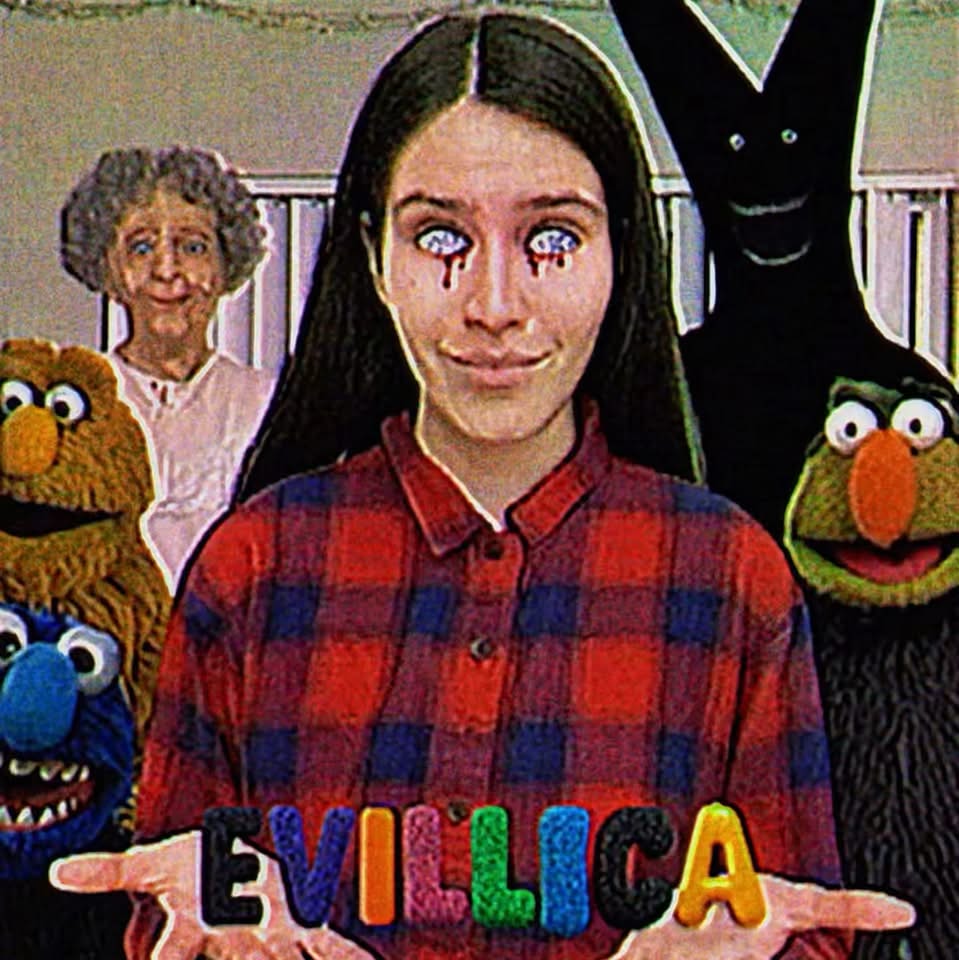
Today I sit down with the lovely and talented videographer known as Evillica, who has quickly amassed a large following on social media for her unsettling and delightful “creepycore” analog horror creations. You can find her content on TikTok, Instagram, and Facebook.
*****
MAD: Thanks so much for taking some time with Horror to Culture today, and the Scary Salad Network! With complete respect to your anonymity as an artist, could you give us some insight into your creative process and how you became interested in video production?
Evillica: My work with video always begins not with an idea, but with a sensation - an image, a mood, an internal state. I usually see the piece as a whole first, and only then select the tools: visuals, sound, rhythm, editing, sometimes narrative - whatever helps transmit that sensation as accurately as possible.
My process is quite structured. It starts with written notes, then moves into detailed storyboarding, where I define everything: composition, color, framing, camera angles, text elements, rhythm, and sometimes even the behavior of characters or creatures. At the storyboard stage, the piece is essentially already complete. As one director once said, my film is finished - it just needs to be shot.
After that, I move on to filming and final assembly. I handle every stage myself, from concept to edit. I didn’t arrive at video immediately - I experimented with writing, drawing, and music - but video ultimately proved to be the most precise and capacious language for expressing what’s happening internally.
*****
MAD: You’ve amassed a considerable following across social media. How do you balance engagement on multiple platforms?
Evillica: Most of the time, I adapt my work for different platforms, but only on a technical level, not conceptually. TikTok, for example, has much stricter limitations when it comes to horror content, so certain moments - especially those involving abrupt visual intensity - sometimes need to be softened so the work can exist on the platform without restricted reach.
That said, I consciously avoid chasing trends or using popular hooks or music if they don’t align with the internal logic of the piece. I’m very careful about this. I don’t want to sacrifice atmosphere, meaning, or quality simply for growth or visibility. If something doesn’t resonate with my vision, I won’t do it.
*****
MAD: You often explore themes of false memories and loss of identity. What scares you personally?
Evillica: On a bodily level, what I experience most often isn’t fear, but anxiety. It manifests as constant tension, emptiness, detachment, and a loss of a stable sense of self. That’s what repeats in my work - not moments of shock, but a sustained state of unease.
We rarely know exactly that something terrible has happened, but we feel that it has. For me, this resembles the awareness of death - not as an event, but as an inescapable condition of all biological life. I’m acutely aware of my own physicality, and I think that’s why anxiety, memory, and the fragility of identity keep resurfacing in my work.
*****
MAD: What are your feelings on the usage of AI in your work, and thoughts on so-called “AI Slop”?
Evillica: I see artificial intelligence as a tool - nothing more, nothing less. Much like green screens, CGI, or Photoshop, it can expand what’s possible when used deliberately. But it should never become the skeleton of the work.
I use a simple test: if AI is removed from the process, does the piece still function conceptually? If the answer is yes, then AI may be justified as an enhancement. If not, authorship becomes blurred - almost like the philosophical paradox of the Ship of Theseus.
As for “AI slop,” I understand why the term exists. When quantity replaces intention, even powerful tools lose their flavor. Excess inevitably dulls perception.
*****
MAD: You seem to use a wide range of tools in your work. Could you tell us more about that?
Evillica: The most important stage for me is storyboarding. That’s where the work fully takes shape - from the visual design of creatures and characters to mood, text, framing, and camera language. Once I move into filming, the storyboard functions as a precise instruction set.
The final assembly is where the most meticulous work happens - refining rhythm, visual tension, and detail. Depending on the concept, I may use anything from mobile editing apps to professional tools like Premiere Pro, After Effects, and Photoshop. Tools are secondary to intention; control and awareness matter more than the software itself.
*****
MAD: Where do you see AI heading in the next few years in terms of creative expression?
Evillica: I think AI will gradually become invisible. It will stop being the subject and turn into background infrastructure - the way editing software or cameras once did. The real question won’t be whether AI is used, but whether a human statement still exists behind the work.
*****
MAD: Do you have aspirations for longer-form projects or film?
Evillica: Yes. In longer formats, I want to explore the themes I’m already working with in greater depth. It’s a way to expand the world and give these ideas a different rhythm - one that allows their philosophical dimension to fully unfold rather than simply capture a fleeting state.
*****
MAD: Who are some of your artistic inspirations?
Evillica: I’m less inspired by specific names than by approaches to form and perception. I’m deeply influenced by Stanley Kubrick for his precision, intellectual discipline, and control over space and time. David Lynch is equally important to me for his ability to speak directly to the subconscious through anxiety and dream logic, without explanation.
I’m also very drawn to puppetry as a language. In that sense, Jim Henson and The Krofft Brothers have been important influences - for their sense of something alive that isn’t fully alive, and for the unsettling physicality that emerges from those forms.
Among visual artists who have stayed with me almost my entire life are H. R. Giger and Zdzisław Beksiński. Their work matters to me not as an aesthetic, but as a state - a way of working with the body, fear, and internal tension that resists full rationalization.
*****
MAD: Do you have any advice for creators who are trying to find their audience?
Evillica: The biggest mistake is giving up. If an idea truly ignites something inside you, you can’t abandon it just because results aren’t immediate. Fast success is rarely meaningful - much like in sports. The most important thing is simply to keep going and not lose sight of why you started in the first place.
*****
MAD: Are you open to collaborations with other digital creators?
Evillica: Absolutely. I’m especially interested in working with musicians, but also with artists, filmmakers, and writers. For me, collaboration is both dialogue and an expansion of language. Cinema and visual art are inherently collective forms - each participant brings a part of themselves, making the final work deeper and more layered.
*****
MAD: In closing, is there anything you would like to leave readers with?
Evillica: Art remains alive as long as it exists in thought - in memory, resonance, and even disagreement. If a work stays with someone after the screen goes dark, it has already fulfilled its purpose.
=====
MAD is the host of the HORROR TO CULTURE podcast, vidcast, and website. He is also a contributor at the SCARY SALAD NETWORK.
I Was Ready To Be Disappointed, But I’m Not

